Res2Net
Introduction
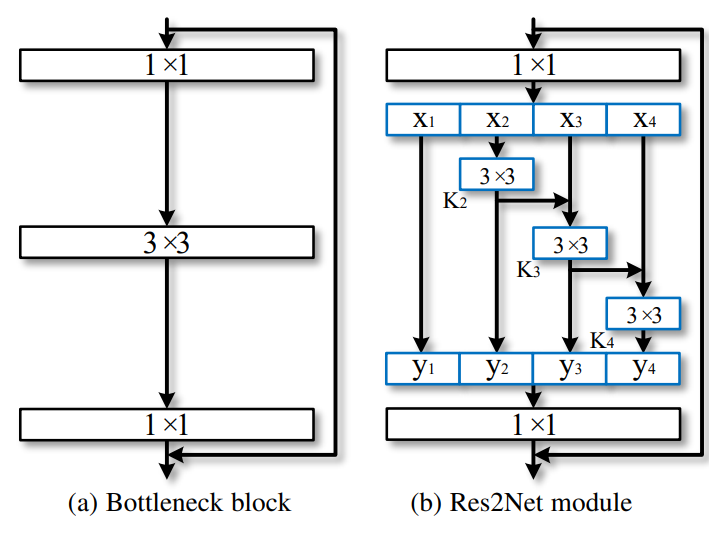
We propose a novel building block for CNNs, namely Res2Net, by constructing hierarchical residual-like connections
within one single residual block. The Res2Net represents multi-scale features at a granular level and increases the
range of receptive fields for each network layer. The proposed Res2Net block can be plugged into the state-of-the-art
backbone CNN models, e.g. , ResNet, ResNeXt, BigLittleNet, and DLA. We evaluate the Res2Net block on all these models
and demonstrate consistent performance gains over baseline models.
Benchmark
| Model | Context | Top-1 (%) | Top-5 (%) | Params (M) | Train T. | Infer T. | Download | Config | Log |
|---|---|---|---|---|---|---|---|---|---|
| Res2Net50 | D910x8-G | 79.35 | 94.64 | 25.76 | 246s/epoch | 28.5ms/step | model | cfg | log |
| Res2Net101 | D910x8-G | 79.56 | 94.70 | 45.33 | 467s/epoch | 46.0ms/step | model | cfg | log |
| Res2Net50 | D910x8-G | 80.32 | 95.09 | 25.77 | 250s/epoch | 29.6ms/step | model | cfg | log |
| Res2Net101-v1b | D910x8-G | 81.26 | 95.41 | 45.35 | 435s/epoch | 42.4ms/step | model | cfg | log |
Notes
All models are trained on ImageNet-1K training set and the top-1 accuracy is reported on the validatoin set.
Context: GPU_TYPE x pieces - G/F, G - graph mode, F - pynative mode with ms function.
Examples
Train
The yaml config files that yield competitive results on ImageNet for different models are listed in the
configsfolder. To trigger training using preset yaml config.mpirun -n 8 python train.py --config configs/res2net/res2net_50_gpu.yaml --data_dir /path/to/imagenet
Detailed adjustable parameters and their default value can be seen in config.py.
Eval
To validate the model, you can use
validate.py. Here is an example for res2net50 to verify the accuracy of your training.python validate.py --config configs/res2net/res2net_50_gpu.yaml --data_dir /path/to/imagenet --ckpt_path /path/to/res2net50.ckpt