Xception
Introduction
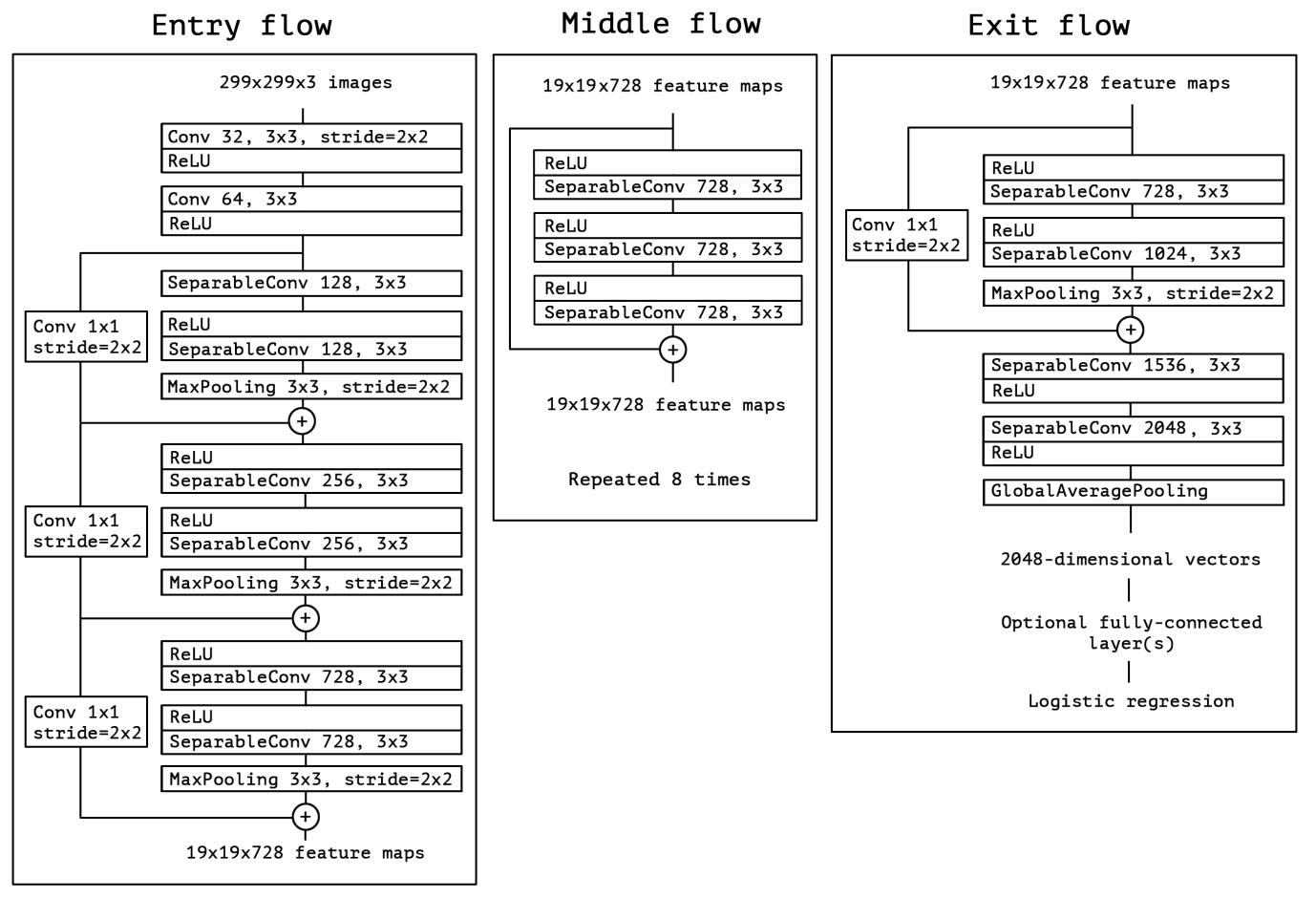
Xception is another improved network of InceptionV3 in addition to inceptionV4, using a deep convolutional neural network architecture involving depthwise separable convolution, which was developed by Google researchers. Google interprets the Inception module in convolutional neural networks as an intermediate step between regular convolution and depthwise separable convolution operations. From this point of view, the depthwise separable convolution can be understood as having the largest number of Inception modules, that is, the extreme idea proposed in the paper, combined with the idea of residual network, Google proposed a new type of deep convolutional neural network inspired by Inception Network architecture where the Inception module has been replaced by a depthwise separable convolution module.
Benchmark
| Pynative | Pynative | Graph | Graph | ||||||
|---|---|---|---|---|---|---|---|---|---|
| Model | Top-1 (%) | Top-5 (%) | train (s/epoch) | Infer (ms) | train(s/epoch) | Infer (ms) | Download | Config | |
| GPU | xception | model | config | ||||||
| Ascend | xception |
Examples
Train
The yaml config files that yield competitive results on ImageNet for different models are listed in the
configsfolder. To trigger training using preset yaml config.comming soon
Here is the example for finetuning a pretrained InceptionV3 on CIFAR10 dataset using Momentum optimizer.
python train.py --model=xception --pretrained --opt=momentum --lr=0.001 dataset=cifar10 --num_classes=10 --dataset_download
Detailed adjustable parameters and their default value can be seen in config.py.
Eval
To validate the model, you can use
validate.py. Here is an example to verify the accuracy of pretrained weights.python validate.py --model=xception --dataset=imagenet --val_split=val --pretrained
To validate the model, you can use
validate.py. Here is an example to verify the accuracy of your training.python validate.py --model=xception --dataset=imagenet --val_split=val --ckpt_path='./ckpt/xception-best.ckpt'